使用 nn.Transformer 和 TorchText 进行序列到序列建模
原文: https://pytorch.org/tutorials/beginner/transformer_tutorial.html
译者: zanshuxun
本教程展示了如何使用nn.Transformer 模块训练一个seq2seq模型。单击此处下载完整的示例代码
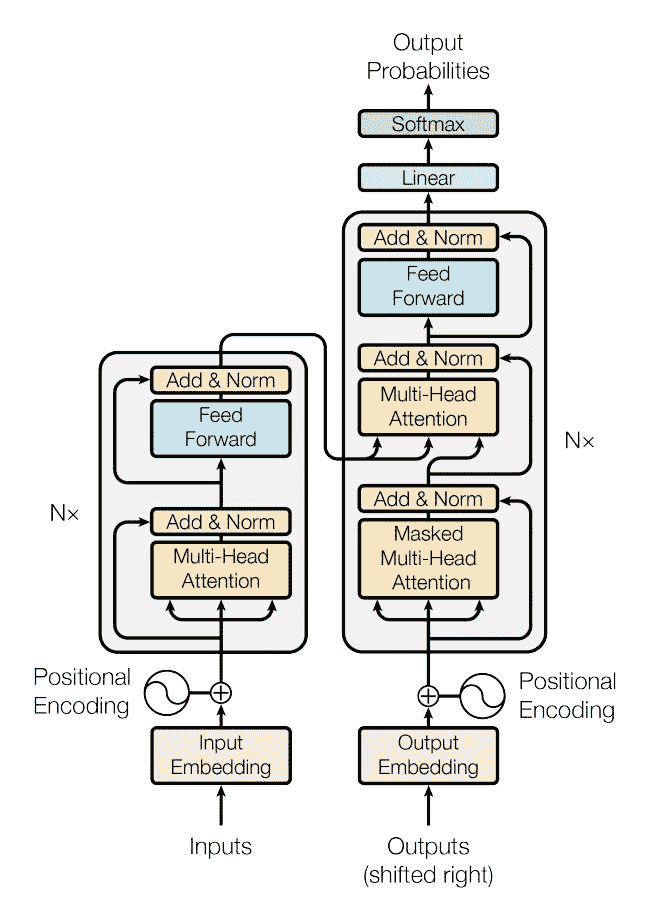
PyTorch 1.2 发布了一个基于论文《Attention is All You Need》的标准transformer模块。transformer模型在很多seq2seq问题上效果更好,且更容易实现并行训练。nn.Transformer模块使用一种注意力机制(最近实现的另一种注意力为 nn.MultiheadAttention)来捕捉输出和输入之间的整体依赖关系。 nn.Transformer做到了高度模块化,其中的单个组件也很容易进行修改和使用(例如本教程中的 nn.TransformerEncoder)。
定义模型
在本教程中,我们训练了一个nn.TransformerEncoder模型来进行语言建模任务。语言建模任务是指:已有一句话,预测其后续出现某个词或某句话的概率。这句话(一串符号)经过嵌入(embedding)层之后,再使用一个位置编码(positional encoding)层来学习其中的词顺序(详见下一段)。nn.TransformerEncoder由多层 nn.TransformerEncoderLayer 组成。除了输入序列之外,还需要一个正方形的注意力掩码矩阵。因为是用已经出现的词预测后面的词,训练过程中模型不能看到后面已经出现的词,需要用mask矩阵掩盖掉。 为了获得每个单词的预测概率,nn.TransformerEncoder后面会接上一个Linear层和softmax层。
import mathimport torchimport torch.nn as nnimport torch.nn.functional as Fclass TransformerModel(nn.Module):def __init__(self, ntoken, ninp, nhead, nhid, nlayers, dropout=0.5):super(TransformerModel, self).__init__()from torch.nn import TransformerEncoder, TransformerEncoderLayerself.model_type = 'Transformer'self.src_mask = Noneself.pos_encoder = PositionalEncoding(ninp, dropout)encoder_layers = TransformerEncoderLayer(ninp, nhead, nhid, dropout)self.transformer_encoder = TransformerEncoder(encoder_layers, nlayers)self.encoder = nn.Embedding(ntoken, ninp)self.ninp = ninpself.decoder = nn.Linear(ninp, ntoken)self.init_weights()def _generate_square_subsequent_mask(self, sz):mask = (torch.triu(torch.ones(sz, sz)) == 1).transpose(0, 1)mask = mask.float().masked_fill(mask == 0, float('-inf')).masked_fill(mask == 1, float(0.0))return maskdef init_weights(self):initrange = 0.1self.encoder.weight.data.uniform_(-initrange, initrange)self.decoder.bias.data.zero_()self.decoder.weight.data.uniform_(-initrange, initrange)def forward(self, src):if self.src_mask is None or self.src_mask.size(0) != len(src):device = src.devicemask = self._generate_square_subsequent_mask(len(src)).to(device)self.src_mask = masksrc = self.encoder(src) * math.sqrt(self.ninp)src = self.pos_encoder(src)output = self.transformer_encoder(src, self.src_mask)output = self.decoder(output)return output
PositionalEncoding模块能够学到一些序列中符号的相对或绝对位置信息。位置编码层的输出维度与嵌入层相同,两者可以相加。这里我们使用sine和cosine函数来学习单词之间的位置信息。
class PositionalEncoding(nn.Module):def __init__(self, d_model, dropout=0.1, max_len=5000):super(PositionalEncoding, self).__init__()self.dropout = nn.Dropout(p=dropout)pe = torch.zeros(max_len, d_model)position = torch.arange(0, max_len, dtype=torch.float).unsqueeze(1)div_term = torch.exp(torch.arange(0, d_model, 2).float() * (-math.log(10000.0) / d_model))pe[:, 0::2] = torch.sin(position * div_term)pe[:, 1::2] = torch.cos(position * div_term)pe = pe.unsqueeze(0).transpose(0, 1)self.register_buffer('pe', pe)def forward(self, x):x = x + self.pe[:x.size(0), :]return self.dropout(x)
加载数据
训练时使用torchtext中的 Wikitext-2 数据集。下面代码中的 vocab 对象可以将数据集中的符号转为张量,batchify()函数用于生成批次数据,将训练集按照batch_size切分为多个序列,并剔除多余的字符。 例如,当输入序列是字母表时(总长度为 26),设置batch_size为 4,batchify()函数会将输入序列分为 4 个长度为 6 的序列:
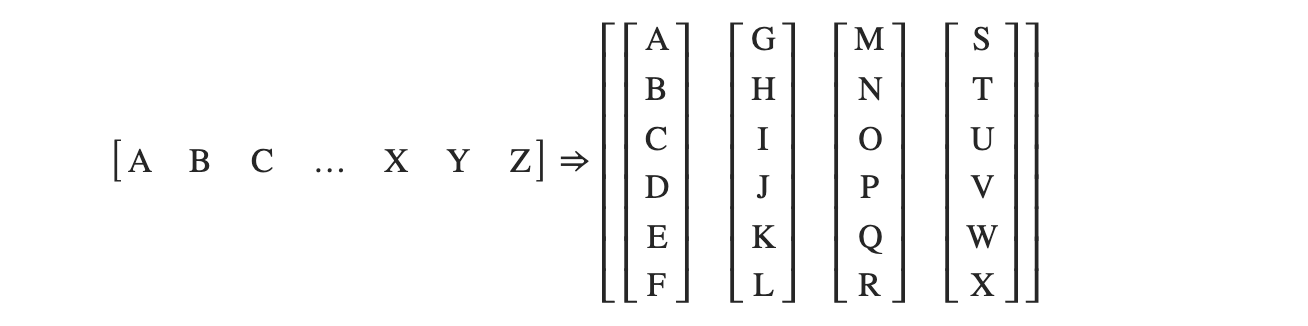
不同列对于模型来说是独立的,这意味模型无法学习G和F的依赖性,但可以进行更有效的批次训练。
import torchtextfrom torchtext.data.utils import get_tokenizerTEXT = torchtext.data.Field(tokenize=get_tokenizer("basic_english"),init_token='<sos>',eos_token='<eos>',lower=True)train_txt, val_txt, test_txt = torchtext.datasets.WikiText2.splits(TEXT)TEXT.build_vocab(train_txt)device = torch.device("cuda" if torch.cuda.is_available() else "cpu")def batchify(data, bsz):data = TEXT.numericalize([data.examples[0].text])# Divide the dataset into bsz parts.nbatch = data.size(0) // bsz# Trim off any extra elements that wouldn't cleanly fit (remainders).data = data.narrow(0, 0, nbatch * bsz)# Evenly divide the data across the bsz batches.data = data.view(bsz, -1).t().contiguous()return data.to(device)batch_size = 20eval_batch_size = 10train_data = batchify(train_txt, batch_size)val_data = batchify(val_txt, eval_batch_size)test_data = batchify(test_txt, eval_batch_size)
输出:
downloading wikitext-2-v1.zipextracting
生成输入序列和目标序列
get_batch()函数为transformer 模型生成输入和目标序列,将源数据切分为长度为bptt的块。 对于语言建模任务,模型需要后面出现的单词作为Target。 例如,bptt值为 2、i = 0 时,get_batch()函数会得到以下两个变量:

注意,每一块数据的第0维与 Transformer 模型中的S维度一致,第1维是批次尺寸N。
bptt = 35def get_batch(source, i):seq_len = min(bptt, len(source) - 1 - i)data = source[i:i+seq_len]target = source[i+1:i+1+seq_len].view(-1)return data, target
初始化模型实例
使用下面的超参数创建模型。 词表大小等于 vocab 对象的长度。
ntokens = len(TEXT.vocab.stoi) # the size of vocabularyemsize = 200 # embedding dimensionnhid = 200 # the dimension of the feedforward network model in nn.TransformerEncodernlayers = 2 # the number of nn.TransformerEncoderLayer in nn.TransformerEncodernhead = 2 # the number of heads in the multiheadattention modelsdropout = 0.2 # the dropout valuemodel = TransformerModel(ntokens, emsize, nhead, nhid, nlayers, dropout).to(device)
运行模型
损失函数采用CrossEntropyLoss , 优化器采用SGD 中实现的随机梯度下降法。初始学习率设置为 5.0。 StepLR 用于在不同的迭代伦次(epochs)中调整学习率。 训练时使用 nn.utils.clipgrad_norm 函数将所有梯度进行缩放,来防止发生梯度爆炸。
criterion = nn.CrossEntropyLoss()lr = 5.0 # learning rateoptimizer = torch.optim.SGD(model.parameters(), lr=lr)scheduler = torch.optim.lr_scheduler.StepLR(optimizer, 1.0, gamma=0.95)import timedef train():model.train() # Turn on the train modetotal_loss = 0.start_time = time.time()ntokens = len(TEXT.vocab.stoi)for batch, i in enumerate(range(0, train_data.size(0) - 1, bptt)):data, targets = get_batch(train_data, i)optimizer.zero_grad()output = model(data)loss = criterion(output.view(-1, ntokens), targets)loss.backward()torch.nn.utils.clip_grad_norm_(model.parameters(), 0.5)optimizer.step()total_loss += loss.item()log_interval = 200if batch % log_interval == 0 and batch > 0:cur_loss = total_loss / log_intervalelapsed = time.time() - start_timeprint('| epoch {:3d} | {:5d}/{:5d} batches | ''lr {:02.2f} | ms/batch {:5.2f} | ''loss {:5.2f} | ppl {:8.2f}'.format(epoch, batch, len(train_data) // bptt, scheduler.get_lr()[0],elapsed * 1000 / log_interval,cur_loss, math.exp(cur_loss)))total_loss = 0start_time = time.time()def evaluate(eval_model, data_source):eval_model.eval() # Turn on the evaluation modetotal_loss = 0.ntokens = len(TEXT.vocab.stoi)with torch.no_grad():for i in range(0, data_source.size(0) - 1, bptt):data, targets = get_batch(data_source, i)output = eval_model(data)output_flat = output.view(-1, ntokens)total_loss += len(data) * criterion(output_flat, targets).item()return total_loss / (len(data_source) - 1)
对训练集最多遍历epochs次。 如果模型在验证集上的损失达到最优,则保存模型。 每一轮训练结束后都会调整学习率。
best_val_loss = float("inf")epochs = 3 # The number of epochsbest_model = Nonefor epoch in range(1, epochs + 1):epoch_start_time = time.time()train()val_loss = evaluate(model, val_data)print('-' * 89)print('| end of epoch {:3d} | time: {:5.2f}s | valid loss {:5.2f} | ''valid ppl {:8.2f}'.format(epoch, (time.time() - epoch_start_time),val_loss, math.exp(val_loss)))print('-' * 89)if val_loss < best_val_loss:best_val_loss = val_lossbest_model = modelscheduler.step()
输出:
| epoch 1 | 200/ 2981 batches | lr 5.00 | ms/batch 29.47 | loss 8.04 | ppl 3112.50| epoch 1 | 400/ 2981 batches | lr 5.00 | ms/batch 28.38 | loss 6.78 | ppl 882.16| epoch 1 | 600/ 2981 batches | lr 5.00 | ms/batch 28.38 | loss 6.38 | ppl 589.27| epoch 1 | 800/ 2981 batches | lr 5.00 | ms/batch 28.40 | loss 6.23 | ppl 508.15| epoch 1 | 1000/ 2981 batches | lr 5.00 | ms/batch 28.41 | loss 6.12 | ppl 454.63| epoch 1 | 1200/ 2981 batches | lr 5.00 | ms/batch 28.40 | loss 6.09 | ppl 441.65| epoch 1 | 1400/ 2981 batches | lr 5.00 | ms/batch 28.42 | loss 6.04 | ppl 418.77| epoch 1 | 1600/ 2981 batches | lr 5.00 | ms/batch 28.41 | loss 6.04 | ppl 421.53| epoch 1 | 1800/ 2981 batches | lr 5.00 | ms/batch 28.40 | loss 5.96 | ppl 387.98| epoch 1 | 2000/ 2981 batches | lr 5.00 | ms/batch 28.41 | loss 5.96 | ppl 386.42| epoch 1 | 2200/ 2981 batches | lr 5.00 | ms/batch 28.42 | loss 5.85 | ppl 346.77| epoch 1 | 2400/ 2981 batches | lr 5.00 | ms/batch 28.42 | loss 5.89 | ppl 362.54| epoch 1 | 2600/ 2981 batches | lr 5.00 | ms/batch 28.42 | loss 5.90 | ppl 364.01| epoch 1 | 2800/ 2981 batches | lr 5.00 | ms/batch 28.43 | loss 5.80 | ppl 329.20-----------------------------------------------------------------------------------------| end of epoch 1 | time: 88.26s | valid loss 5.73 | valid ppl 307.01-----------------------------------------------------------------------------------------| epoch 2 | 200/ 2981 batches | lr 4.51 | ms/batch 28.58 | loss 5.79 | ppl 328.13| epoch 2 | 400/ 2981 batches | lr 4.51 | ms/batch 28.42 | loss 5.77 | ppl 319.25| epoch 2 | 600/ 2981 batches | lr 4.51 | ms/batch 28.42 | loss 5.60 | ppl 270.79| epoch 2 | 800/ 2981 batches | lr 4.51 | ms/batch 28.44 | loss 5.63 | ppl 279.91| epoch 2 | 1000/ 2981 batches | lr 4.51 | ms/batch 28.44 | loss 5.58 | ppl 265.99| epoch 2 | 1200/ 2981 batches | lr 4.51 | ms/batch 28.44 | loss 5.61 | ppl 273.55| epoch 2 | 1400/ 2981 batches | lr 4.51 | ms/batch 28.42 | loss 5.63 | ppl 277.59| epoch 2 | 1600/ 2981 batches | lr 4.51 | ms/batch 28.45 | loss 5.66 | ppl 287.09| epoch 2 | 1800/ 2981 batches | lr 4.51 | ms/batch 28.44 | loss 5.58 | ppl 266.00| epoch 2 | 2000/ 2981 batches | lr 4.51 | ms/batch 28.44 | loss 5.61 | ppl 272.58| epoch 2 | 2200/ 2981 batches | lr 4.51 | ms/batch 28.44 | loss 5.50 | ppl 244.59| epoch 2 | 2400/ 2981 batches | lr 4.51 | ms/batch 28.44 | loss 5.57 | ppl 262.87| epoch 2 | 2600/ 2981 batches | lr 4.51 | ms/batch 28.44 | loss 5.58 | ppl 265.65| epoch 2 | 2800/ 2981 batches | lr 4.51 | ms/batch 28.44 | loss 5.51 | ppl 246.48-----------------------------------------------------------------------------------------| end of epoch 2 | time: 88.16s | valid loss 5.53 | valid ppl 253.40-----------------------------------------------------------------------------------------| epoch 3 | 200/ 2981 batches | lr 4.29 | ms/batch 28.58 | loss 5.55 | ppl 256.02| epoch 3 | 400/ 2981 batches | lr 4.29 | ms/batch 28.43 | loss 5.55 | ppl 256.76| epoch 3 | 600/ 2981 batches | lr 4.29 | ms/batch 28.46 | loss 5.36 | ppl 212.31| epoch 3 | 800/ 2981 batches | lr 4.29 | ms/batch 28.44 | loss 5.42 | ppl 225.88| epoch 3 | 1000/ 2981 batches | lr 4.29 | ms/batch 28.46 | loss 5.38 | ppl 217.24| epoch 3 | 1200/ 2981 batches | lr 4.29 | ms/batch 28.45 | loss 5.41 | ppl 223.82| epoch 3 | 1400/ 2981 batches | lr 4.29 | ms/batch 28.43 | loss 5.42 | ppl 226.87| epoch 3 | 1600/ 2981 batches | lr 4.29 | ms/batch 28.44 | loss 5.47 | ppl 238.34| epoch 3 | 1800/ 2981 batches | lr 4.29 | ms/batch 28.45 | loss 5.41 | ppl 223.13| epoch 3 | 2000/ 2981 batches | lr 4.29 | ms/batch 28.45 | loss 5.44 | ppl 230.23| epoch 3 | 2200/ 2981 batches | lr 4.29 | ms/batch 28.44 | loss 5.32 | ppl 205.28| epoch 3 | 2400/ 2981 batches | lr 4.29 | ms/batch 28.44 | loss 5.40 | ppl 221.60| epoch 3 | 2600/ 2981 batches | lr 4.29 | ms/batch 28.45 | loss 5.42 | ppl 224.76| epoch 3 | 2800/ 2981 batches | lr 4.29 | ms/batch 28.44 | loss 5.34 | ppl 209.38-----------------------------------------------------------------------------------------| end of epoch 3 | time: 88.18s | valid loss 5.48 | valid ppl 240.75-----------------------------------------------------------------------------------------
在测试集上评估模型
在测试集上使用保存的最优模型来评估效果。
test_loss = evaluate(best_model, test_data)print('=' * 89)print('| End of training | test loss {:5.2f} | test ppl {:8.2f}'.format(test_loss, math.exp(test_loss)))print('=' * 89)
输出:
=========================================================================================| End of training | test loss 5.39 | test ppl 219.13=========================================================================================
脚本的总运行时间:(4 分钟 42.167 秒)

若有收获,就点个赞吧
0 人点赞


